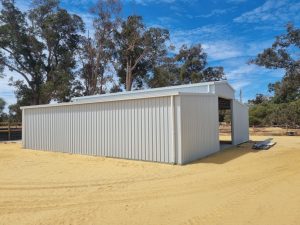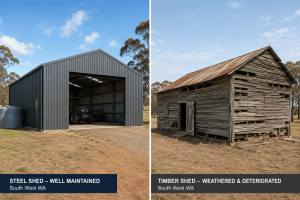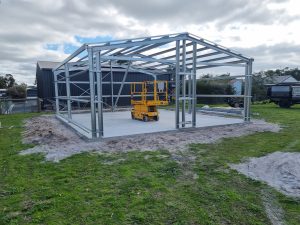
Most people building a farm shed spend a lot of time thinking about footprint — the length, the width, how many bays. The roof profile is an afterthought. It gets decided late in the process, often without much guidance, and that’s when problems start.
The wrong roof choice for your site can mean poor drainage on a property that gets 800mm of rain a year. It can mean a ceiling line that’s too low for your header. It can mean a structure that catches wind badly on an exposed rural block. And unlike a door size or a colour choice, the roof is not something you fix cheaply after the fact.
Getting the roof right from the start means your shed works the way it should — on day one and ten years from now. This guide explains the three main roof types used on farm sheds across South West WA, what each one does well, and how to match the right profile to your property and your operation.
Key Takeaways:
- Gable roofs suit most general-purpose farm sheds — hay, machinery, workshops, and multi-bay structures
- Skillion roofs are best for lean-to additions, shade shelters, and single-use structures where cost and simplicity matter
- Custom and multi-span configurations suit large or complex builds, highly exposed sites, and sheds that need to serve distinct functions side by side
- Roof pitch matters as much as profile — coastal properties in South West WA benefit from a steeper pitch to handle high winter rainfall
Gable vs. Skillion vs. Custom Shed Roof Type : A Practical Summary
Choose a gable roof if:
- You need maximum internal volume and overhead clearance
- The shed will store hay, large machinery, or tall equipment
- The site is exposed and needs to handle wind from multiple directions
- You want a versatile, proven profile that suits most farm shed applications
Choose a skillion roof if:
- The shed is a lean-to addition or a single-use structure
- Council height restrictions are a factor on your block
- You need drainage directed in a specific direction
- You’re building a livestock shade shelter or open-front equipment bay
- Build cost is a priority on a smaller structure
Consider a custom or multi-span configuration if:
- You need a wide span without intermediate support columns
- The shed serves multiple distinct functions that benefit from separate bays
- The site is highly exposed and a hip or Dutch gable profile would reduce wind uplift
- You’re adding to an existing shed and need the new structure to connect cleanly
Not sure which applies to your situation? That’s exactly the conversation to have before you commit to a design.
Get a free quote from Westspan Sheds — or call 08 6722 8894 to talk through your roof options with Tristan and the team.
Short on time? The interactive widget below covers the essentials at a glance.
Farm Shed Roof Types Explained
Two equal panels meeting at a central ridge — rain sheds off both sides
Key advantages
- Maximum internal height at the ridge — fits tall machinery, headers, and stacked bales
- Balanced wind resistance from all directions — no weak face
- Efficient drainage off both sides — critical in 750–900mm rainfall zones
- Straightforward ridge venting for livestock, dairy, and hay sheds
Single panel sloping from high wall to low — drainage directed in one direction
Key advantages
- Lower build cost — simpler frame with fewer structural components
- Lower overall height — useful where council height restrictions apply
- Directed drainage — ideal next to existing structures or collection points
- The standard approach for lean-to additions alongside existing sheds
Two gable spans joined at an internal valley — wide, open floor area without intermediate posts
What makes it different
- Wide span without intermediate columns — clear, unobstructed floor area
- Multiple bays serve distinct uses — machinery, hay, workshop — side by side
- Dutch gable or hip variants reduce wind uplift on exposed coastal and hilltop sites
- Gable + skillion lean-to combination is one of the most practical farm layouts
Answer two quick questions and we’ll point you toward the right roof for your property and intended use.
Recommendation
Ready to discuss your shed? Westspan Sheds — South West WA’s local experts for over 15 years.
Get a free quoteWhat Are the Main Roof Types Used on Farm Sheds in Australia?
The three most common roof profiles for agricultural sheds in Australia are gable, skillion, and custom or multi-span configurations. Each has a distinct shape, a different set of structural characteristics, and a range of applications it suits best.
Understanding the differences before committing to a design means fewer compromises during the build — and a shed that genuinely works for your operation rather than one you have to work around.
What Is a Gable Roof and When Does It Work Best?
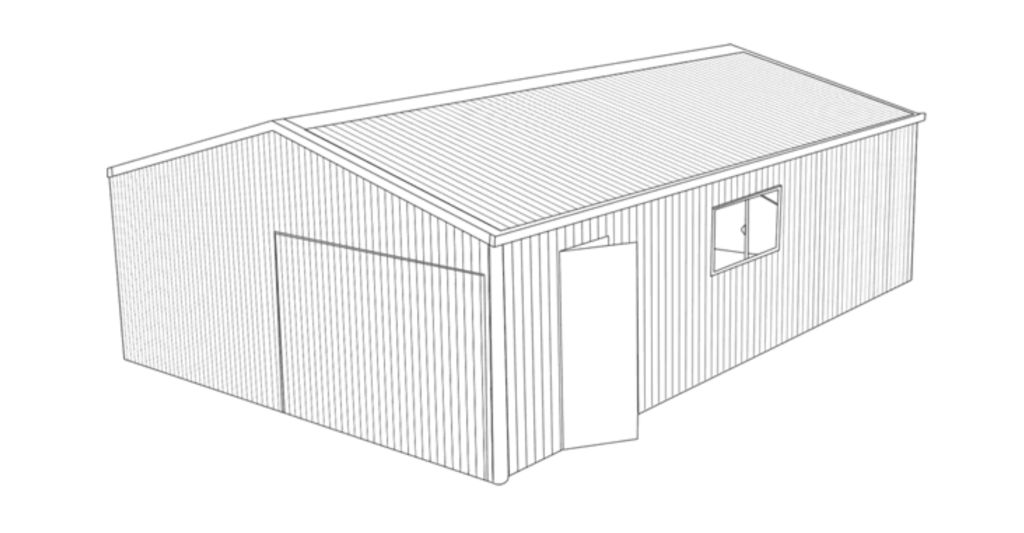
Get maximum internal height, strong wind resistance from all directions, and efficient drainage off both sides — that is what a gable roof delivers, and it is why it is the most common profile on farm sheds across Australia.
A gable roof has two equal panels that slope upward from the eaves and meet at a central ridge. The triangular end walls this creates are called the gable ends. The shape is immediately recognisable and structurally proven across decades of Australian agricultural construction.
What are the advantages of a gable roof on a farm shed?
- Maximum overhead clearance at the ridge — the peaked centre creates usable height for tall equipment, stacked hay bales, or crane access in a workshop
- Symmetrical load distribution — both sides of the roof carry an equal share of wind and rain loads, which contributes to long-term structural performance
- Efficient water runoff — rain sheds quickly off both sides, reducing the risk of water pooling or tracking back under the sheeting
- Natural ridge ventilation — a gable profile makes ridge venting straightforward to incorporate, which matters significantly in livestock, dairy, and hay sheds
When is a gable roof the right choice?
A gable roof is the right default for most farm sheds. Hay storage, machinery sheds, workshops, and multi-purpose rural sheds all perform well under a gable profile.
It is also the stronger choice on properties where the shed sits in an exposed position and needs to handle wind loads from multiple directions — something Tristan and the team at Westspan see regularly across the coastal and elevated rural areas between Busselton and Augusta.
What Is a Skillion Roof and When Does It Work Best?
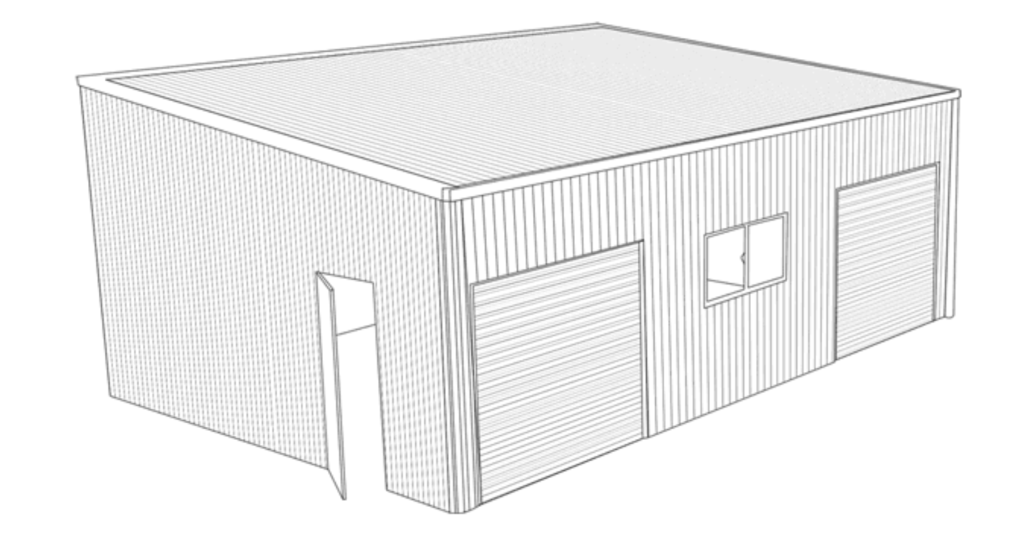
Where simplicity and cost efficiency matter more than maximum internal volume, a skillion roof delivers. It is a single sloping panel running from a high wall on one side down to a lower wall on the other — no central ridge, no complex framing.
What are the advantages of a skillion roof on a farm shed?
- Lower build cost — fewer structural components and a simpler frame reduce cost on smaller or single-use structures
- Lower overall roof height — useful where council height restrictions apply, as a skillion can achieve the required internal eave height while keeping the peak lower than a comparable gable
- Directed drainage — rain runs off in a single defined direction, which is practical when you need runoff away from a neighbouring structure or toward a specific collection point
- Easy lean-to attachment — skillion roofs are the standard approach for additions alongside existing sheds or farm buildings
When is a skillion roof the right choice?
Skillion roofs suit livestock shade structures, open-front equipment bays, fertiliser and chemical storage sheds, and lean-to additions where a simpler structure makes more practical and financial sense than a full gable frame.
One thing to be aware of: on the high-rainfall coastal fringe of South West WA — around Busselton, Dunsborough, Margaret River, and Augusta — a skillion roof with a low pitch needs careful design. The pitch and gutter sizing must be matched to local rainfall intensity. In these areas, properties can receive 750–900mm of rain per year, with intense winter events that deliver significant volumes quickly. A skillion roof that drains well in a drier inland location may not perform adequately in these zones without a steeper pitch and correctly sized guttering.
What Are Custom and Multi-Span Roof Configurations?
For larger or more complex farm sheds, there are configurations beyond the standard gable and skillion. The most common is the multi-span or double-gable roof, which joins two or more gable spans side by side to create a wider structure without requiring oversized structural members.
What is a multi-span or double-gable shed roof?
A multi-span shed uses two gable frames connected at a shared internal valley. This allows considerably wider buildings to be constructed cost-effectively — the alternative of a single very wide gable span would require much heavier and more expensive steel throughout.
Multi-span configurations are common on large hay storage sheds, workshop sheds with separate bays for different activities, and dairy sheds where functional zones need clear physical separation.
The key consideration with multi-span roofs is valley drainage. The internal valley between spans must be designed with sufficient gradient and downpipe capacity to clear rainfall without pooling or backing up under the sheeting. This is particularly important on coastal South West WA properties where rainfall intensity during winter storms can be significant.
What other custom roof options are worth considering?
- Dutch gable — a hybrid of gable and hip that reduces wind uplift at the gable ends while retaining much of the internal volume of a standard gable. Worth considering on highly exposed coastal or hilltop sites around Margaret River, Dunsborough, and the Capes region
- Hip roof — all four sides slope downward, eliminating the gable ends entirely. More structurally complex and typically more expensive, but delivers strong wind resistance in all directions — relevant for very exposed rural properties
- Combination profiles — a gable main shed with skillion lean-to bays on one or both sides is one of the most practical configurations on working farms, allowing distinct zones for machinery, hay, chemicals, or workshop use within a single connected structure

How Does Roof Pitch Affect Your Farm Shed?
Pitch — the angle of the roof slope — is a separate decision from profile, and it matters just as much. It affects drainage performance, internal space, wind resistance, and the surface area of steel sheeting required.
For steel-clad agricultural sheds in Australia, the minimum recommended pitch is typically 5 degrees. Most farm sheds are built in the 5–15 degree range.
In South West WA, the coastal fringe receives considerably more rainfall than inland areas. Properties around Busselton, Dunsborough, and Augusta average 750–900mm per year. For these locations, a pitch of 10–15 degrees performs noticeably better than the minimum — it clears water faster and reduces the risk of it tracking back under the sheeting during heavy events.
Inland areas around Bunbury, Harvey, and Donnybrook tend to be drier. Lower pitches perform adequately in most cases, though steeper pitches still improve long-term drainage performance.
Higher pitches do increase the total surface area of roof sheeting and the structural loads the frame carries — your builder will factor this into the engineering when calculating material and construction costs.
How Does Roof Type Affect Wind Performance in South West WA?
Wind is a genuine structural consideration across South West WA. Coastal properties and elevated rural land between Busselton and Augusta can experience sustained winds and seasonal storm events that place real loads on shed structures.
The roof profile interacts with wind in two primary ways: uplift and lateral load.
Uplift is the force that acts to lift the roof off the walls. Gable roofs with steeper pitches can be more susceptible to uplift at the gable ends. Hip and Dutch gable profiles reduce this exposure by eliminating the flat vertical gable end face. Skillion roofs experience high uplift on the low-pitch face depending on wind direction.
Lateral load is the horizontal pressure that transfers through the frame and into the walls and footings. Symmetrical gable roofs handle lateral loads from multiple directions reliably. Skillion frames are engineered to resist loads primarily from the high-wall direction.
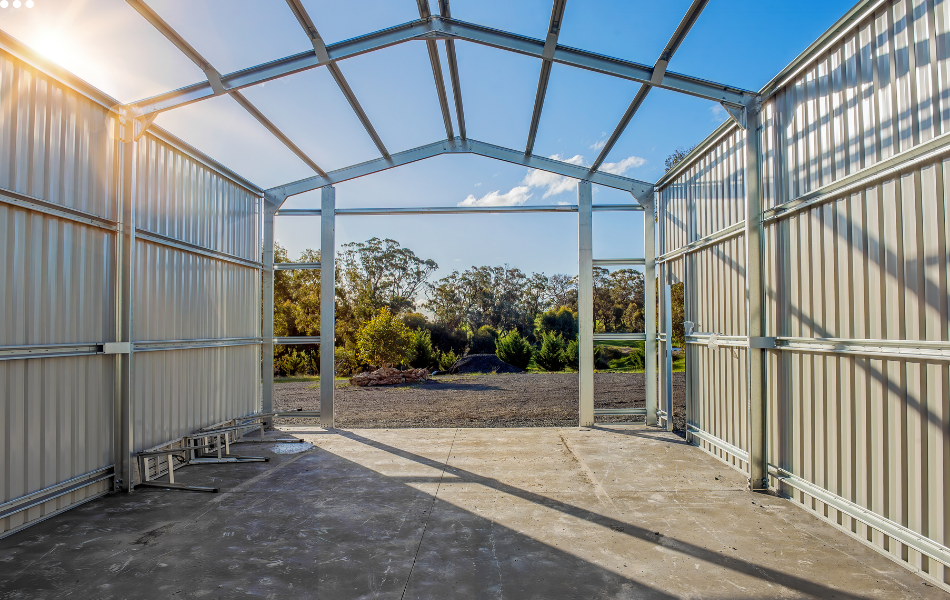
All Westspan sheds are engineered to the relevant Australian Standards for their wind region and terrain category. With over 15 years of experience building across South West WA, the team understands the specific wind exposures that come with coastal blocks, hilltop rural properties, and valley-floor sites — and designs accordingly.
How Does Westspan Approach the Roof Type Decision?
The roof profile recommendation comes out of a real conversation about your property, your equipment, your intended use, and your site conditions — not from a default template applied to every build.
With over 15 years designing and constructing farm sheds across Busselton, Margaret River, Bunbury, Donnybrook, Dunsborough, Capel, Augusta, and the wider South West WA region, Westspan has designed gable, skillion, multi-span, and combination roofs across a wide range of agricultural applications. That hands-on experience — from a team led by a trained boilermaker who has erected these structures himself — means the advice you get is grounded in what actually works in this part of the world.
“Nothing was a problem, erected the shed in the time frame that he said and kept us updated along the way.” — Kim Arrowsmith, Westspan customer
Frequently Asked Questions About Farm Shed Roof Types
Which roof type is most common on Australian farm sheds?
The gable roof is the most widely used profile on farm sheds across Australia, including South West WA. It suits the broadest range of applications and delivers a reliable balance of internal space, drainage performance, and structural integrity.
Does the roof type affect the cost of a farm shed?
Yes. A skillion roof is generally the most cost-effective option due to its simpler frame. A gable roof sits in the mid range for most spans. Multi-span and hip roof configurations typically cost more due to the additional structural components and design complexity involved.
What is the minimum roof pitch for a steel farm shed?
The minimum recommended pitch for steel-clad agricultural sheds in Australia is typically 5 degrees. In higher-rainfall areas like coastal South West WA, a pitch of 10 degrees or more is preferable for reliable year-round drainage performance.
Can I add a skillion lean-to bay to an existing gable shed?
Yes — and this is one of the most common farm shed configurations we build. A skillion lean-to can be attached to one or both sides of an existing gable shed to add covered area for equipment, chemicals, or feed storage without requiring an entirely new structure.
How does Westspan decide which roof type to recommend?
The team works through your intended use, the dimensions you need, local wind and rainfall conditions, any council height restrictions on your property, and your overall budget. The roof profile recommendation follows from that — not the other way around.
Do I need council approval regardless of which roof type I choose?
Approval requirements in South West WA depend on your shed’s size, your property’s zoning, and your local council — not the roof profile specifically. Westspan manages the engineering and approval documentation as part of every build.
Ready to Choose the Right Roof for Your Farm Shed?
The roof type decision is straightforward when you have the right information and the right people to guide you through it. The team at Westspan Sheds builds farm sheds across South West WA and knows what works — and what doesn’t — in this region’s conditions.
Get a free quote or call 08 6722 8894 to talk through your roof type options today.