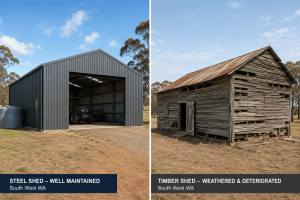
Key takeaways
- Colorbond steel sheds from Westspan come pre-painted with a factory-applied coating system that outperforms most aftermarket paints in longevity and UV resistance.
- If you are repainting an older steel shed, a zinc-based primer followed by a two-pack epoxy or polyurethane topcoat gives the best protection in South West WA conditions.
- Coastal and high-rainfall properties between Busselton and Augusta should specify a coating rated for marine or C3/C4 corrosion categories.
- Paint alone will not fix structural rust. Treat corroded panels before repainting or the coating will fail within two to three seasons.
- Interior surfaces exposed to chemicals, fertiliser dust, or livestock waste need a different product to exterior walls. Read on for a full breakdown by shed type and environment.
Farm sheds take a hard beating in South West WA. Coastal salt air, summer heat, driving rain, and the chemical load from fertilisers and livestock waste all attack unprotected steel. The right coating slows that attack down significantly. The wrong one peels off within a season and leaves you worse off than before.
This post covers the main coating options for farm sheds, when each one makes sense, and what to watch for in South West WA conditions specifically. It is written for property owners who are either planning a new shed or looking to maintain or repaint an existing one.

Does a New Steel Shed Need Painting?
If your shed is built with Fielders or Fielders Endurance steel, the short answer is no. Factory-applied Colorbond coatings are a multi-layer system baked on during manufacture. They include a zinc-based corrosion inhibitor primer, a chemical conversion layer, and a polyester resin topcoat. The result outperforms almost anything you can apply on site.
These coatings are tested to Australian Standards for salt spray, humidity, and UV exposure. On a properly installed shed in South West WA conditions, a factory finish will typically last 15 to 25 years before any maintenance is needed, provided the shed is not near a chemical spray zone or directly on a coastal dune.
Where paint becomes relevant is on older sheds, exposed cut edges, penetrations, or areas where the factory coating has been compromised.
When You Do Need to Paint or Re-coat
Four situations call for a coating decision:
- Cut edges and penetrations. Factory-coated steel is vulnerable at cut edges. On-site cutting exposes bare zinc. Apply a zinc-rich cold galvanising compound to these areas immediately, before moisture gets in.
- Existing shed maintenance. If you are repainting an older shed where the original coating is worn, chalking, or flaking, you need to strip and prime before topcoating, not paint over the problem.
- Interior surfaces. Many shed owners focus entirely on the exterior and neglect interior walls and roof steelwork. In hay sheds, fertiliser sheds, and dairy sheds, interior surfaces take significant chemical exposure. These need a purpose-appropriate coating.
- Concrete and flooring. The slab and concrete walls in workshop and machinery sheds benefit from a dedicated floor coating, particularly where oil and hydraulic fluid are present.
Coating Systems for Farm Sheds: What the Options Are
Not all paints are equal, and marketing language in the paint trade can be confusing. The table below covers the main coating types used on steel farm sheds.
| Coating type | What it is | Best for | Limitations |
| Cold galvanising / zinc-rich primer | High-zinc spray or brush-applied primer | Cut edges, bare steel repairs, welded joins | Topcoat required for UV resistance |
| Direct-to-metal (DTM) acrylic | Water-based single-pack paint | Low-demand exterior surfaces, low-budget applications | Shorter service life in harsh environments |
| Two-pack epoxy | Chemical-cured epoxy primer or topcoat | Interiors, chemical exposure zones, concrete | Can chalk and yellow under UV; use polyurethane over it on exteriors |
| Two-pack polyurethane | High-durability topcoat, solvent-based | Exterior walls and roofs requiring long service life | Higher cost; application requires skill |
| Intumescent / fire-resistant coatings | Fire-retardant specialty coatings | Structural steel in commercial or industrial sheds | Not relevant to most farm sheds |
| Concrete floor coating | Epoxy or polyurethane floor paint | Workshop and machinery shed floors | Surface prep is the main failure point |
For most farm shed repaints in South West WA, a zinc primer followed by a two-pack polyurethane topcoat is the system that delivers the best return on investment.
Corrosion Categories: Why Location Matters
The steel in a shed 2 kilometres inland from the coast and the steel in a shed on the Augusta foreshore face very different environments. Australian Standard AS 4312 classifies atmospheric corrosivity into categories from C1 (very low) to CX (extreme). Most South West WA rural properties fall into C2 or C3. Properties within 1 kilometre of the coast, or in wet gullies with consistent moisture, can reach C4.
Annual rainfall — Busselton to Augusta coastal strip
750–900 mm/yr
High-rainfall zone — accelerates timber deterioration and coating breakdown
Inland South West WA rural
C2–C3
Low to medium corrosivity
Coastal — within 1km of ocean
C3–C4
Medium to high corrosivity
Salt spray testing — C4-rated coatings
1,000 hrs minimum
AS/NZS 2312 requirement for high-corrosivity coastal environments
A C4-rated coating system typically includes a thicker film build, a more aggressive zinc primer, and a topcoat resin that resists hydrolysis. If you are on a coastal or high-rainfall block, ask your paint supplier for the product’s corrosivity category rating before purchasing.
Interior Coatings by Shed Type
Interior coating needs vary significantly by what the shed stores or houses.
Hay sheds
Hay sheds carry moisture-rich organic material. The main risk is condensation on internal steel surfaces, combined with spores and organic acids from decomposing material. An epoxy sealer on internal walls and roof sheets slows surface corrosion and makes washdown easier.
Fertiliser sheds
Fertiliser is one of the most corrosive materials stored in farm buildings. Ammonium nitrate, urea, and single superphosphate all react with steel over time. Internal surfaces in fertiliser sheds should be coated with a chemical-resistant epoxy, and the floor should be sealed with a chemical-resistant floor coating. Some properties use a combination of coated steel walls and a polyethylene or fibreglass liner at floor level.
Dairy farm sheds
Effluent, cleaning chemicals, and persistent moisture make dairy shed interiors one of the harshest environments in agriculture. Two-pack epoxy on all internal steel below 1.2 metres is standard practice. Wall and floor junctions need particular attention as this is where moisture collects.
Machinery sheds and workshops
The main concern with farm machinery sheds here is oil penetration into the slab and general corrosion from weather exposure on the exterior. A penetrating epoxy floor sealer on the slab, followed by a topcoat in high-traffic areas, handles the floor. Exterior walls typically need to be cleaned and repainted every 10 to 15 years, depending on the aspect and weather exposure.
Surface Preparation: The Part Most People Get Wrong
Coating failure on farm sheds is rarely a product problem. It is almost always a preparation problem.
For exterior steel, the preparation sequence is:
- Wash the entire surface to remove dust, bird droppings, oil residue, and salt deposits. A pressure washer with a diluted degreaser works well.
- Sand or grind any areas with visible rust back to bare steel. Surface rust that is painted over will continue to spread under the coating.
- Apply a zinc-rich primer to any bare steel areas within the same day. Steel starts to oxidise quickly in humid conditions.
- Allow the primer to cure fully before topcoating. Follow the manufacturer’s recoat window exactly.
- Apply two coats of topcoat. Single-coat applications on farm sheds rarely last as long as the product spec suggests.
The temptation is to skip preparation steps to save time. On a large shed this is understandable. The problem is that an under-prepared surface will fail in two to three years rather than ten, and you will be back doing the same job again.
Quick-Reference Coating Guide
| Situation | Recommended system |
| New Fielders steel shed | No painting required. Check cut edges and treat with zinc primer. |
| Older shed, sound original coating, light chalking | Clean, degrease, apply DTM acrylic topcoat |
| Older shed, heavy chalking, flaking paint | Strip to bare steel, zinc primer, two-pack polyurethane topcoat |
| Visible rust on panels | Grind to bare steel, treat with rust converter if needed, zinc primer, two-pack polyurethane |
| Fertiliser shed interior | Chemical-resistant epoxy on walls; chemical-resistant floor coating on slab |
| Dairy shed interior | Two-pack epoxy below 1.2m; standard epoxy above; sealed floor |
| Workshop floor | Penetrating epoxy sealer, polyurethane topcoat in high-traffic zones |
| Coastal property (within 1km of ocean) | C4-rated coating system. Ask for the product’s corrosivity rating before purchase. |
FAQ
How often should I repaint a farm shed in South West WA?
On a Fielders steel shed with the original factory coating intact, 15 to 20 years before any repainting is common in most rural South West WA locations. Coastal or high-rainfall sites may need attention closer to 10 to 12 years. The indicator to watch is chalking on the painted surface. When the colour becomes chalky or powdery to the touch, the resin is beginning to break down and repainting within the next one to two seasons makes sense.
Can I paint over Colorbond steel?
Yes, but the surface needs to be clean and the existing coating needs to be sound. If the factory coating is still adhering well, lightly scuff the surface to improve adhesion, degrease thoroughly, and apply a compatible topcoat. If the original coating is peeling or flaking, you need to strip the affected areas back and prime before topcoating.
What is the best paint colour for a farm shed roof in terms of heat?
Lighter colours reflect more solar radiation. A pale grey or white Colorbond roof will run significantly cooler internally than a dark charcoal. In a machinery shed where heat is not a major concern, colour is mostly a personal choice. In a dairy shed, grain shed, or workshop where people or temperature-sensitive materials spend time, a light roof colour makes a real practical difference.
Do I need special paint for a fertiliser shed?
Yes. Standard exterior paints will deteriorate quickly in a fertiliser environment. You need a chemical-resistant epoxy formulated for agricultural chemical exposure. Ask the manufacturer directly whether the product is suitable for contact with the specific fertiliser types you store. Some nitrogen-based fertilisers are more aggressive than others.
Is it worth painting the inside of a hay shed?
For a basic open-front hay shed that only stores dry baled hay, interior painting is low priority. If the shed stores silage or mixed materials that create condensation and organic acid exposure, an interior epoxy sealer extends the life of the steel and makes the shed easier to clean.
If you are planning a new farm shed and want to know which steel specification and coating system is right for your site and use, talk to the Westspan team.