Key Takeaways
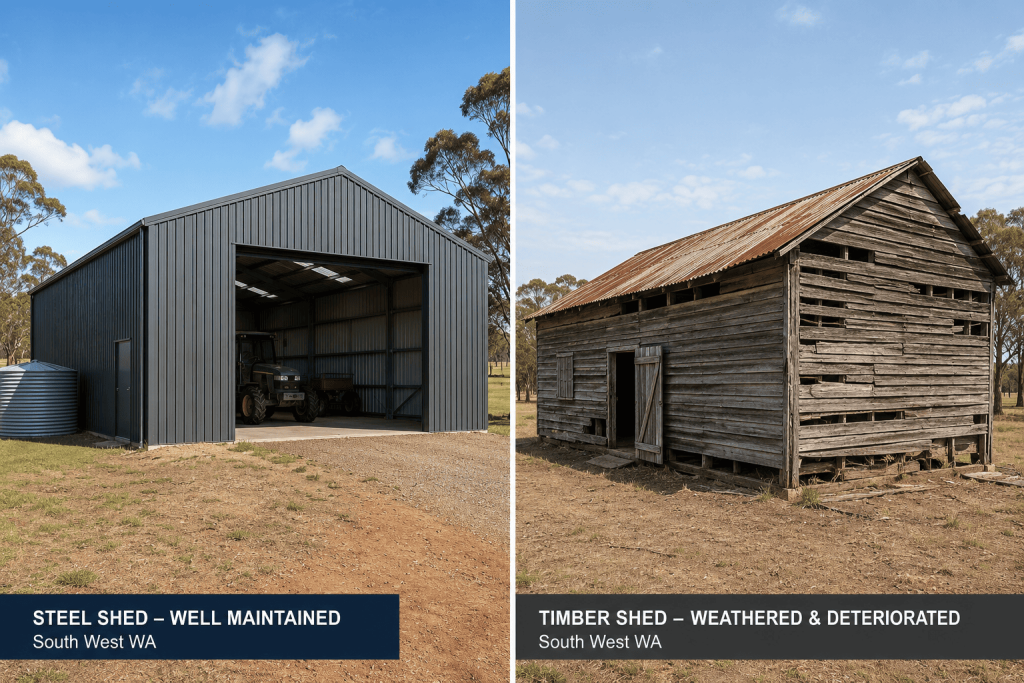
- Steel farm sheds consistently outlast timber in Australian farm conditions, typically lasting 30–50+ years with minimal maintenance when built to standard.
- Timber sheds are vulnerable to rot, termite damage, and moisture in South West WA’s high-rainfall coastal environment (750–900mm annually in some areas).
- Steel carries a higher upfront cost in most configurations, but lower lifetime maintenance costs make it cheaper over a 20–30 year horizon.
- For hay, machinery, grain, and dairy applications, steel is the practical choice for longevity and structural integrity.
- Timber may suit smaller, low-use rural lifestyle structures where aesthetics are a priority and longevity expectations are shorter.
- All Westspan farm sheds are built from premium Fielders and Fielders Endurance steel, engineered to Australian Standards for wind region and site conditions.
Read on for a full breakdown of how each material performs across the factors that matter most on a working farm.
Why material choice matters more on a farm than anywhere else
A farm shed works harder than almost any other structure on a rural property. It holds hay, protects machinery worth hundreds of thousands of dollars, shelters livestock, or functions as a daily-use workshop. The loads are heavy, the weather is unforgiving, and the shed rarely gets the maintenance attention that a residential building would.
In South West WA, the environment adds another layer of pressure. Properties between Busselton and Augusta receive 750–900mm of annual rainfall. Coastal and hilltop sites face sustained wind loads classified under Wind Region A and B. The material your shed is built from has a direct bearing on whether it holds up under those conditions for 10 years, 30 years, or longer.
The question farmers ask most often is straightforward: does steel or timber last longer? The answer, across most farm applications, is steel. But it is worth understanding why, and where timber still has a place.
How steel and timber perform over time
Structural integrity over decades
Steel does not rot, warp, or split. A steel portal frame shed, built to Australian Standards and erected correctly, holds its shape across decades. The frame carries the same load in year 30 as it did in year one.
Timber moves. It expands and contracts with moisture and temperature changes, which creates ongoing stress at joints and connections. In a dry, stable climate, a well-built timber structure can last generations. South West WA is not that climate. High rainfall, seasonal humidity, and coastal salt air accelerate the processes that degrade timber from the inside out.
Termite and pest risk
Termites are a genuine risk on rural properties throughout Western Australia, and timber sheds are a target. A termite infestation in a load-bearing timber frame is not just a maintenance problem; it is a structural safety problem. Treatment helps, but it requires regular reapplication and professional inspection to remain effective.
Steel has no nutritional value to termites or any other pest. The risk simply does not exist.
Corrosion in steel vs decay in timber
The counter-argument for timber is that steel corrodes. This is accurate but manageable. Modern agricultural steel, particularly Fielders Endurance, is engineered for Australian conditions with high-performance metallic coating systems designed to resist corrosion even in coastal and high-humidity environments.
Timber decay, by contrast, is harder to arrest once it begins. By the time visible deterioration is apparent, the structural damage is often well advanced. Steel corrosion is visible early and addressable with spot treatment before it becomes a structural issue.
Maintenance: what each material actually demands
Steel shed maintenance requirements
A steel farm shed in good condition needs very little. Annual or biannual checks cover most properties:
- Inspect fasteners and flashings for any early rust spots, and treat with appropriate primer
- Clear gutters and downpipes to prevent water pooling at the base of wall sheets
- Check door hardware, hinges, and sliding track mechanisms
- Look for any physical damage from farm equipment, and address sheet dents or gaps that could trap moisture
For coastal properties between Dunsborough and Augusta, an annual wash-down of the exterior surfaces using fresh water helps remove salt deposits that would otherwise accelerate surface oxidation.
Timber shed maintenance requirements
Timber demands more time, more frequently, and with more serious consequences if deferred. Typical requirements include:
- Regular re-treatment or re-painting of all exposed surfaces, generally every 3–5 years
- Annual inspection for signs of termite activity, rot, or moisture ingress at ground contacts and joints
- Replacement of individual structural members as decay progresses
- Re-tensioning or refastening of connections as the timber moves seasonally
Deferring timber maintenance does not mean the work disappears. It means the work becomes more expensive and the structural integrity decreases in the meantime.
Comparative performance across common farm shed types
| Shed type | Steel performance | Timber performance | Recommended material |
| Hay shed | Excellent — no moisture absorption, no pest risk | Poor — hay moisture accelerates decay, termite risk high | Steel |
| Machinery shed | Excellent — handles heavy loads, wide spans without columns | Moderate — span limitations, floor load concerns over time | Steel |
| Grain shed | Excellent — airtight options available, no contamination risk | Poor — timber can absorb grain moisture, pest ingress risk | Steel |
| Dairy farm shed | Excellent — handles wash-down, humidity, chemical exposure | Poor — moisture and chemical exposure degrade timber rapidly | Steel |
| Workshop | Excellent — fire-resistant, robust, spans well | Moderate — viable for low-use workshops, fire risk higher | Steel (preferred) |
| Rural lifestyle shed | Good — lower maintenance, strong, long life | Good — suitable where aesthetics are the priority and use is light | Either, depending on priorities |
The cost argument: upfront vs lifetime
Timber can be cheaper to build initially, depending on the shed type, size, and specification. For a small, simple structure, the cost gap is real. For larger agricultural buildings, the gap narrows as the span requirements and structural loads favour steel framing systems.
The lifetime cost picture looks different. Factor in:
- Timber treatment and repainting every 3–5 years
- Termite inspections and treatments annually
- Structural member replacement as decay progresses
- Potential loss of stored goods or equipment if a structural failure occurs
Steel’s maintenance costs are lower and more predictable. For a shed expected to last 30–50 years, the lifetime cost of a steel build is generally lower even where the upfront cost is higher.
Key statistics: steel vs timber shed lifespan, South West WA rainfall and wind region
Steel shed design life
30–50 yrs+
With correct maintenance
Treated timber shed life
15–25 yrs
Before major structural work, high-rainfall WA
Annual rainfall
750–900 mm
Busselton to Augusta
Wind region
A & B
Most South West WA properties
What about heritage or aesthetic preference?
Some rural lifestyle and acreage property owners choose timber for its appearance. A timber-framed shed can suit a heritage homestead setting or a rural lifestyle property where the shed is a relatively low-use ancillary structure.
That is a legitimate choice where aesthetics genuinely matter and the expected lifespan is shorter. It is not the right choice for a working farm shed that will hold significant hay, machinery, or livestock, or one that needs to perform for 30 or more years.
If the visual outcome is the priority, there are steel cladding profiles and colour options that complement older rural properties without the maintenance liabilities of a timber frame.
Quick-reference guide: choose the right material for your property
Choose steel if:
- The shed will hold hay, grain, machinery, livestock, or chemicals
- The property is in a high-rainfall area (most of South West WA qualifies)
- The site has known or potential termite activity
- The shed needs to last 30+ years with minimal structural maintenance
- Wide spans or heavy roof and floor loads are involved
- The property is coastal or receives sustained wind loading
Timber may suit if:
- The structure is a small rural lifestyle shed with light, occasional use
- Appearance needs to match an existing heritage or homestead setting
- The expected lifespan is 15–20 years and the budget is genuinely limited
- The site is dry, low-rainfall, and away from known termite zones (less common in WA)
FAQ
Does steel rust in coastal areas of South West WA?
Steel can corrode in salt-air environments if it is not specified correctly for the location. Westspan uses Fielders and Fielders Endurance steel, which carries metallic coating systems designed for Australian coastal conditions. An annual wash-down with fresh water and prompt attention to any fastener or flashing issues is generally sufficient maintenance for coastal sites.
Can a steel shed be designed to match older farm buildings?
Yes. Steel cladding is available in a range of profiles and colours that complement heritage-style rural properties. Corrugated profiles in heritage colour ranges are commonly used for this purpose. The steel frame does not need to be visible in the finished shed.
Is timber ever used in Westspan builds?
Westspan builds in steel throughout. The structural and longevity advantages of steel for South West WA farm conditions are clear, and it is what the team specifies for every agricultural, commercial, and industrial build.
How long does a steel farm shed actually last?
A steel shed built to Australian Standards and maintained correctly has a design life of 30–50 years or more. The limiting factors are usually site-specific, such as corrosion from extreme coastal exposure or physical damage from farm equipment, rather than material failure under normal conditions.
Does a larger farm shed need engineering approval regardless of material?
Yes. Farm sheds over certain dimensions require building permits and structural engineering in WA, regardless of whether they are steel or timber. Westspan manages engineering certification and council approvals as part of the full supply-and-install service.
What finance options are available for a steel farm shed?
Westspan offers HandyPay finance for qualifying builds. Talk to the team about your project and they can walk you through the options.
Talk to the Westspan team about your farm shed
If you are planning a hay shed, machinery shed, or any other agricultural shed across South West WA, Westspan builds to order with no off-the-shelf kits, full engineering, and complete installation from slab to ridge cap.
Tristan and the team have 15+ years of local experience designing and erecting farm sheds from Bunbury to Augusta. Every build is engineered to the specific wind region and site conditions of your property.